Semrush Reports Google Providing Inaccurate Results To Rank Trackers
Google is returning incorrect results to automated rank trackers, according to Semrush, but the impact on users' tracked rankings has been limited. This issue affects the accuracy of search engine optimization data.
Original reporting · searchenginewatch.com
Original: “Semrush says Google is feeding rank trackers bad results, but impact is limited”
Read “Semrush says Google is feeding rank trackers bad results, but impact is limited” at Search Engine Watch →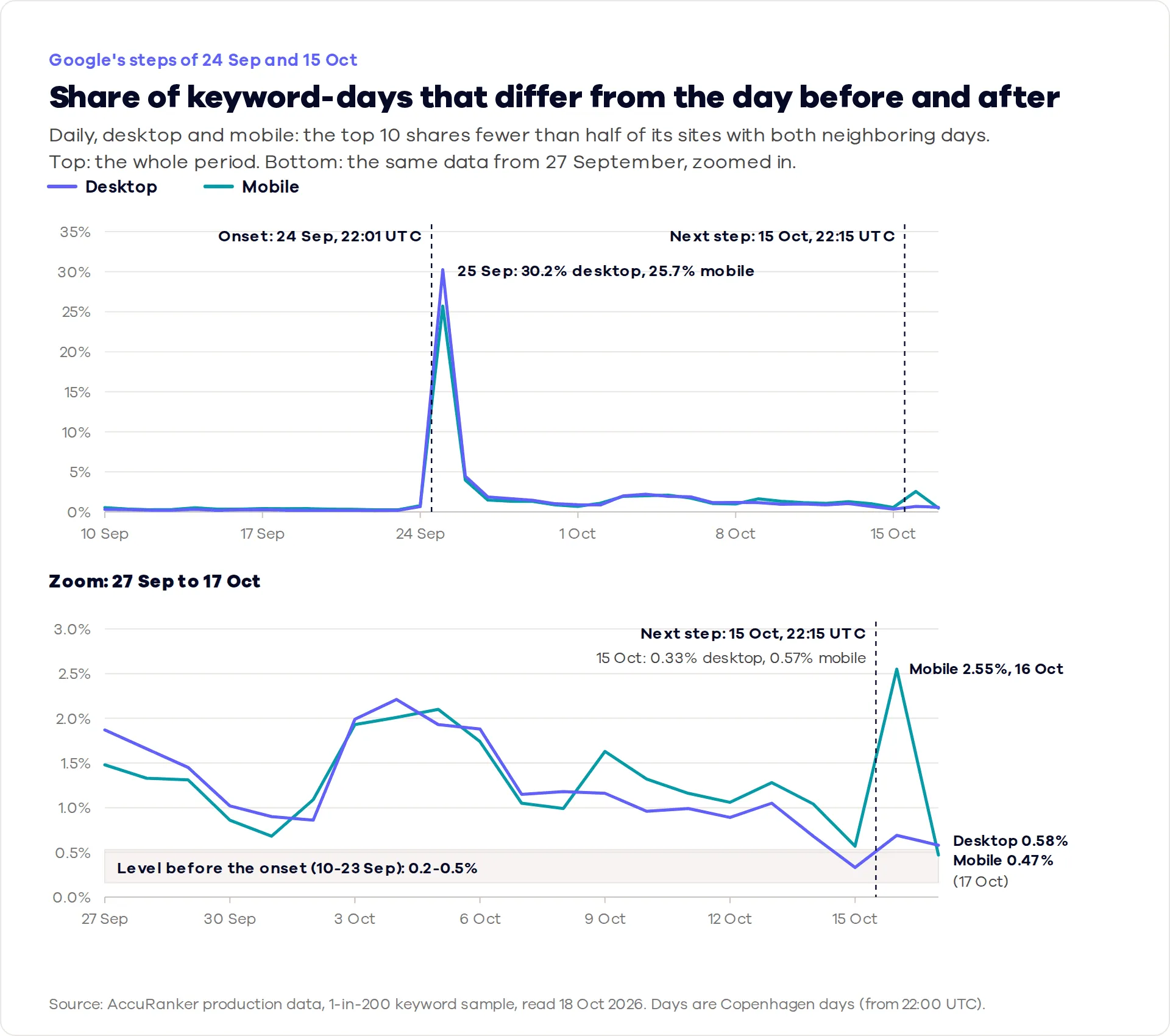
How this was written. The 5:45 Ops Desk wrote this article with a language model from Search Engine Watch’s reporting (model: @cf/meta/llama-3.3-70b-instruct-fp8-fast); it describes that reporting rather than adding to it. The original, linked above, is the full story.
Key points from Search Engine Watch’s report
- Google is returning inaccurate results to automated rank trackers, affecting the accuracy of search engine optimization data.
- The issue primarily affects deeper results, rather than page one rankings, and has been observed by multiple rank trackers.
- SEOs believe that Google may be intentionally poisoning results to prevent AI scrapers from using its data, resulting in collateral damage for rank trackers.
- Users should check Google Search Console to verify ranking drops and ask their rank trackers about their methods for detecting bad pages.
- The problem is not unique to Semrush and has affected other data providers, requiring SEOs and rank trackers to adapt their strategies.
Search Engine Watch reported that Semrush has acknowledged Google's return of inaccurate results to automated collectors since late summer. This phenomenon, known as 'poisoned SERPs,' occurs when Google returns a complete page with incorrect results, rather than an error message or CAPTCHA.
The issue has been observed by other rank trackers, including AccuRanker and Nozzle, which have published their own data on the problem. AccuRanker's analysis showed a sharp spike in late September, while Nozzle found that 8% of its SERPs were poisoned during the same period.
Semrush has stated that the problem primarily affects deeper results, rather than page one rankings, and that its team has implemented extra checks to filter and double-check results. The company has also encouraged users to report any inconsistencies to its support team.
Nozzle's analysis revealed that poisoned pages often feature different websites in the top 10, with Reddit and Facebook taking more prominent positions. The company also found that legal queries were disproportionately affected, with 51.3% of poisoned pages occurring on September 27.
Other SEO consultants, such as Brodie Clark, believe that Google may be intentionally poisoning results to prevent AI scrapers from using its data. This theory suggests that rank trackers are experiencing collateral damage as a result of Google's efforts to combat scraping.
To address the issue, SEOs are advised to check Google Search Console before acting on a ranking drop. This can help determine whether the drop is due to a poisoned check or an actual change in rankings. Additionally, users should ask their rank trackers about their methods for detecting and re-checking bad pages.
The problem of poisoned SERPs is not unique to Semrush, and other data providers have been affected as well. SerpApi, for example, has an open issue regarding irrelevant results on its Google Search API. As the issue continues to evolve, SEOs and rank trackers must adapt their strategies to ensure accurate data.
Questions and answers
What is a poisoned SERP?
A poisoned SERP is a Google results page that appears complete and normal but contains incorrect results, often with different websites in the top 10.
How can I determine if a ranking drop is due to a poisoned check?
Check Google Search Console to see if impressions and position held steady, indicating that the drop was in the tracker's data, not in Google.
Why is Google returning inaccurate results to rank trackers?
The exact reason is unclear, but some SEOs believe that Google may be intentionally poisoning results to prevent AI scrapers from using its data.